The haircut library · Decision guide
How to Compare Haircuts for Your Face Shape
Compare where a cut draws the eye: at the crown, around the cheeks, at the jaw, or below it.
How should face shape guide a haircut? Use it to compare the placement of length, cut lines, and volume—not to rule out a style. A blunt edge draws attention where it ends; layers and bangs can move the visual focus. Start with the silhouette you like, then adjust its details to suit your hair texture and daily routine.
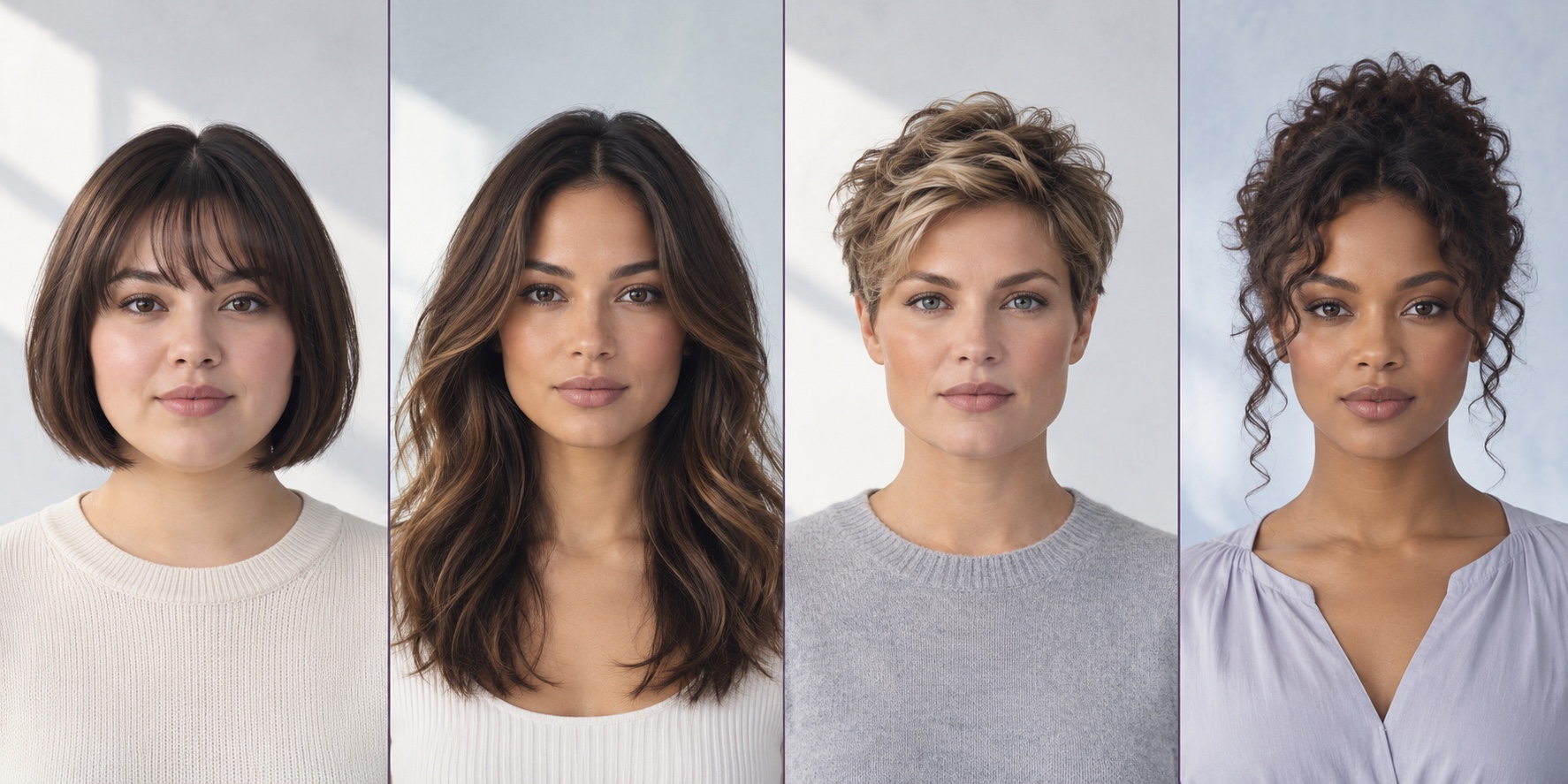
The Geometry of Hair Balance: Why Face Shapes Matter
Look at a haircut as an outline around your face. A strong horizontal edge, such as a blunt bob at the chin, gives the eye a clear stopping point near the jaw. A long, uninterrupted side section creates more of a vertical line. Neither effect is automatically better; the question is which one supports the shape you want to see.
Volume matters as much as length. Height near the crown can make the overall silhouette look taller. Fullness at the cheeks makes the middle of the silhouette look wider. Fullness below the jaw can add visual weight lower down. Soft layers, waves, and an off-center part may also soften the appearance of angular lines; a cleaner edge can give a rounder outline more definition. These are styling choices, not rules about which features need to be corrected.
Before saving a reference, ask where its widest point sits and where its shortest face-framing piece ends. Those two landmarks usually tell you more than the model’s face-shape label.
Quick Face Shape Identification (Without Complex Tools)
Pull your hair back loosely and look straight into a mirror in even light. Compare the apparent width of your forehead, cheekbones, and jaw, then notice whether your face looks longer than it is wide. A straight-on photo can help, but camera angle, expression, and your hairline can change the impression. You do not need exact measurements or a perfect category.
- Round: The face looks close to as wide as it is long, with a softly curved jaw and noticeable width through the cheeks.
- Oval: The face looks longer than it is wide, with gently narrowing forehead and jaw lines.
- Square: The forehead, cheeks, and jaw look similar in width, with a more defined jaw angle.
- Heart: The forehead appears wider than the jaw, with the outline narrowing toward the chin.
- Diamond: The cheekbones appear widest, with a narrower forehead and jaw.
- Long or oblong: The face appears distinctly longer than it is wide; the forehead, cheeks, and jaw may be closer in width than on an oval face.
If you see a mix—perhaps an oval length with a squarer jaw—describe those visible proportions instead of forcing a single label. You can compare haircut examples by the effect you want, regardless of category.
Comparing Haircuts Across Common Face Shapes
The illustration below holds the face, angle, and light steady while moving the widest part of the hair silhouette. It shows where the visual weight lands, not a promised result on your own hair.
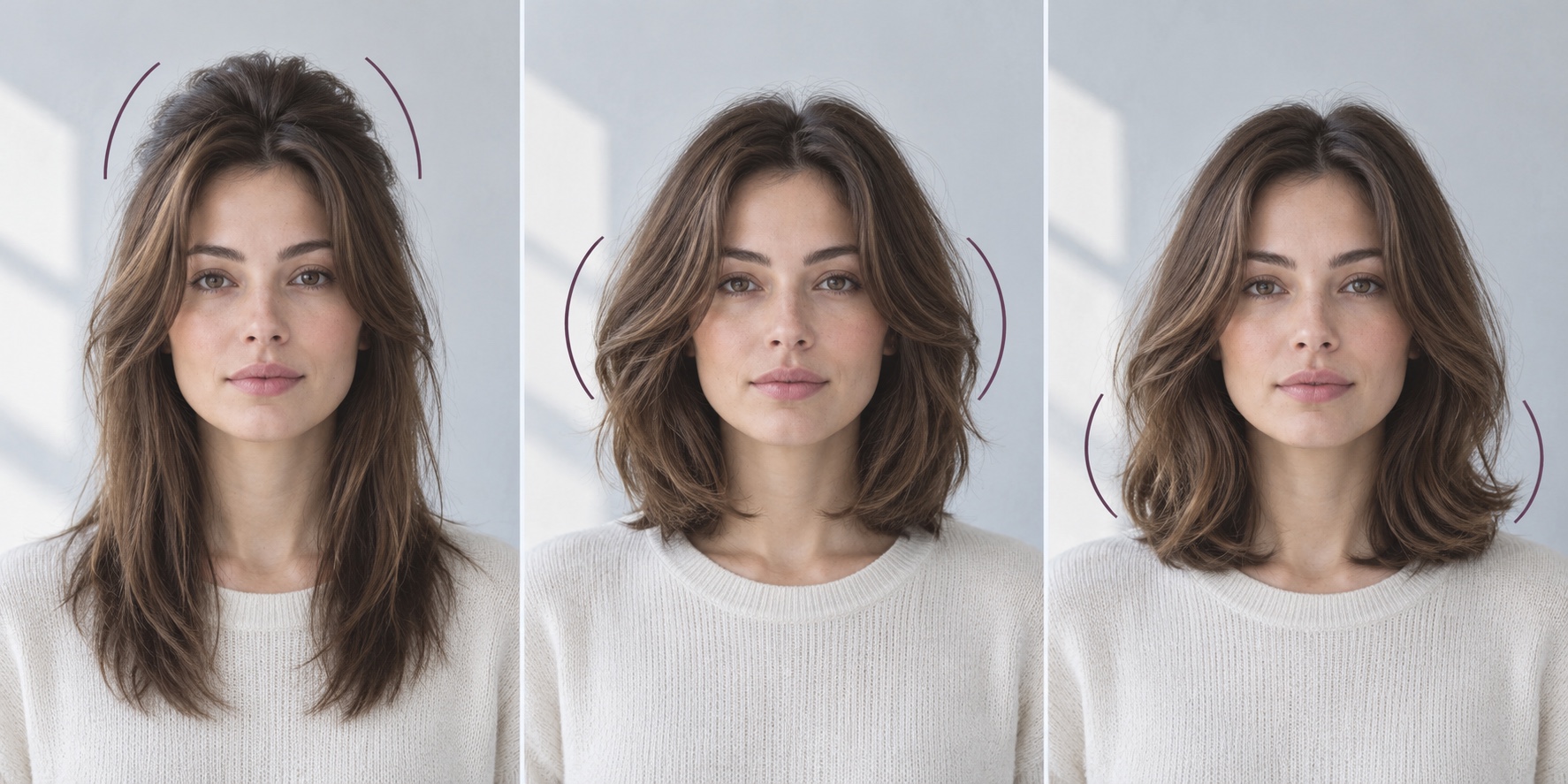
Round Faces: Vertical Lines & Crown Volume
If you want a longer-looking outline, compare a lob that falls below the chin, long face-framing pieces, or light lift at the crown. A strong, rounded shape that is widest exactly at cheek level emphasizes width there. That can be a deliberate choice, too. Check the round-face haircut guide for a closer comparison of lengths and volume placement.
Oval Faces: Silhouette Freedom & Avoiding Excess Length
An oval label does not require one particular cut. A short bob can emphasize the jaw; a collarbone cut can frame the cheekbones; longer hair can emphasize vertical length. If long hair feels visually heavy, compare face-framing movement or a more defined perimeter before cutting it much shorter. See the oval-face haircut guide for focused examples.
Square Faces: Soft Framing & Texture
If you want a softer line around a defined jaw, compare curtain bangs, an off-center part, or textured pieces that end below the jaw. Waves can interrupt a straight outer edge. If you like a crisp, graphic shape instead, a blunt bob can emphasize the jawline beautifully. Decide whether you prefer that definition or a more broken-up outline.
Heart & Diamond Shapes: Balancing the Lower Third
For a heart-shaped outline, a chin- to collarbone-length cut can bring visual fullness closer to the jaw. For a diamond-shaped outline, consider where the cheekbones are widest: movement near the jaw or a fringe at the forehead can shift attention toward narrower areas. In both cases, the exact landing point of a bob matters more than the name of the cut. A bob length comparison can help you describe the edge you want.
For a long or oblong face, compare a fringe or side volume if you want the silhouette to appear less vertical. Long, flat sides can emphasize length, while a collarbone cut with movement can create more width. You can also choose a sleek long style simply because you prefer it.
The Role of Bangs and Layers in Reshaping Balance
Bangs change how much of the forehead remains visible. A short, straight fringe creates a firm horizontal line high on the face. Curtain bangs open around the center and make diagonal lines toward the cheekbones or jaw. Compare the point where the fringe separates and where its longest pieces finish. The curtain-bangs guide explains those choices in more detail.
Face-framing layers can bring attention to different landmarks: cheekbone-length pieces frame the middle of the face; chin-length pieces meet the jaw; longer pieces guide the eye toward the neck and shoulders. Ask to see the shortest layer on your own dry hair, especially if it curls or springs upward. The layers guide explores how that starting point changes the outline.
Let your natural texture and the work you are willing to do shape the final choice. A photo of a smooth blowout cannot show how the same cut will fall when air-dried. If a reference depends on frequent heat styling, the American Academy of Dermatology recommends limiting heat and using lower settings. Use the haircut and routine guide to compare what you can repeat on an ordinary day.
Frequently Asked Questions
Can a person have a combination of two face shapes?
Yes. Face-shape names are shorthand for proportions, and many faces share features of more than one category. Describe the width of your forehead, cheekbones, and jaw, plus the amount of length you see. Then choose the haircut effect you prefer instead of looking for a perfect label.
Is a bob cut suitable for all face shapes?
It can be adapted for many different proportions. A bob ending at the chin draws attention there; one ending below the jaw or near the collarbone changes the focus. The width of the sides, part, fringe, and natural texture matter too. Compare those details with a stylist before choosing a length.
Does hair texture override face shape rules?
Texture affects how the cut actually sits; face shape helps describe a visual preference. Curly hair may look shorter when dry, and dense or fine hair may hold volume in different places. Start by seeing how your hair falls naturally, then use length, layers, and framing to build the silhouette you want. A reference or virtual preview is a conversation aid, not a guarantee of the finished cut.