The haircut library · Decision guide
How to Prepare for a Haircut Consultation: The Stylist Communication Blueprint
Bring a few useful references, name the length you want, and agree on what the cut should do on an ordinary day.
What should I say at a haircut consultation? Start with the result you want, then point to a dry-length landmark on your own hair: collarbone, jaw, or another clear point. Show reference photos for the overall shape, back length, and front pieces, and explain how you normally style your hair. Before cutting begins, ask your stylist to repeat the plan in terms you both understand.

A haircut consultation works best when you describe a visible result and a repeatable routine. “Just a trim” can mean different amounts to different people. Instead, show where you want the ends to land when dry, where the shortest front piece may begin, and whether you want the lower edge to look solid or soft. Ask the stylist to show you those points on your hair before any length comes off. If you are still deciding between cuts, our guide to choosing a haircut helps you compare length and styling effort first.
The Reference Photo Rule: Match Texture, Not Just the Cut
A reference photo shows a direction, not a guarantee. Look at the model’s natural bend or curl, apparent hair density, and the way the photo has been styled. A heavily brushed, dense hairstyle can suggest a different outline from the same cut worn air-dried on fine strands. You can still bring a photo with a different texture; tell the stylist which part you like and ask what would change on your hair. Hair educator Sam Villa advises using the consultation to discuss hair texture, everyday styling, and what the client wants to keep.
Bring three photos with different jobs:
- Overall silhouette: a front or three-quarter view showing the length and fullness you like.
- Back length and edge: a rear view that makes the perimeter line—the lower edge of the cut—clear.
- Front pieces: a close view of the bangs or layers around the face.
Three is a practical starting set, not a rule. If a photo hides the back or shows a blowout you will not recreate, say so. Explain which detail you want from each image, rather than asking the stylist to combine them without discussion. If your hair curls or springs up as it dries, judge length in its dry shape; the curly-hair guide explains that trade-off.
The Hairdresser Translation Guide: What to Say Instead
Technical labels can help, but landmarks and boundaries are easier to check together. Use the examples below as conversation starters, then let the stylist suggest a technique for your hair.
Swipe across the table to see every comparison.
| Instead of | Try saying | Confirm together |
|---|---|---|
| “Give me layers.” | “I’d like soft face-framing pieces starting around my chin, while keeping a full-looking lower edge.” | Where the shortest piece will fall dry and how much weight stays at the ends. See the layers guide. |
| “Take out a lot of volume.” | “The back feels heavy. Can we reduce some internal weight while keeping the ends from looking too wispy?” | Which area will be lightened and whether any thinning or texturizing at the ends fits your goal. |
| “I want bangs.” | “I’d like curtain bangs with the outer pieces near my cheekbones, ideally long enough to tuck back. Can we check that on my hair?” | The shortest center piece, how the fringe parts, and whether it will stay behind your ears. See the curtain-bangs guide. |
If a phrase sounds unfamiliar, point to the area in a photo or mirror and ask the stylist to show the proposed length with their fingers. The goal is a shared picture of the cut, not perfect salon vocabulary.
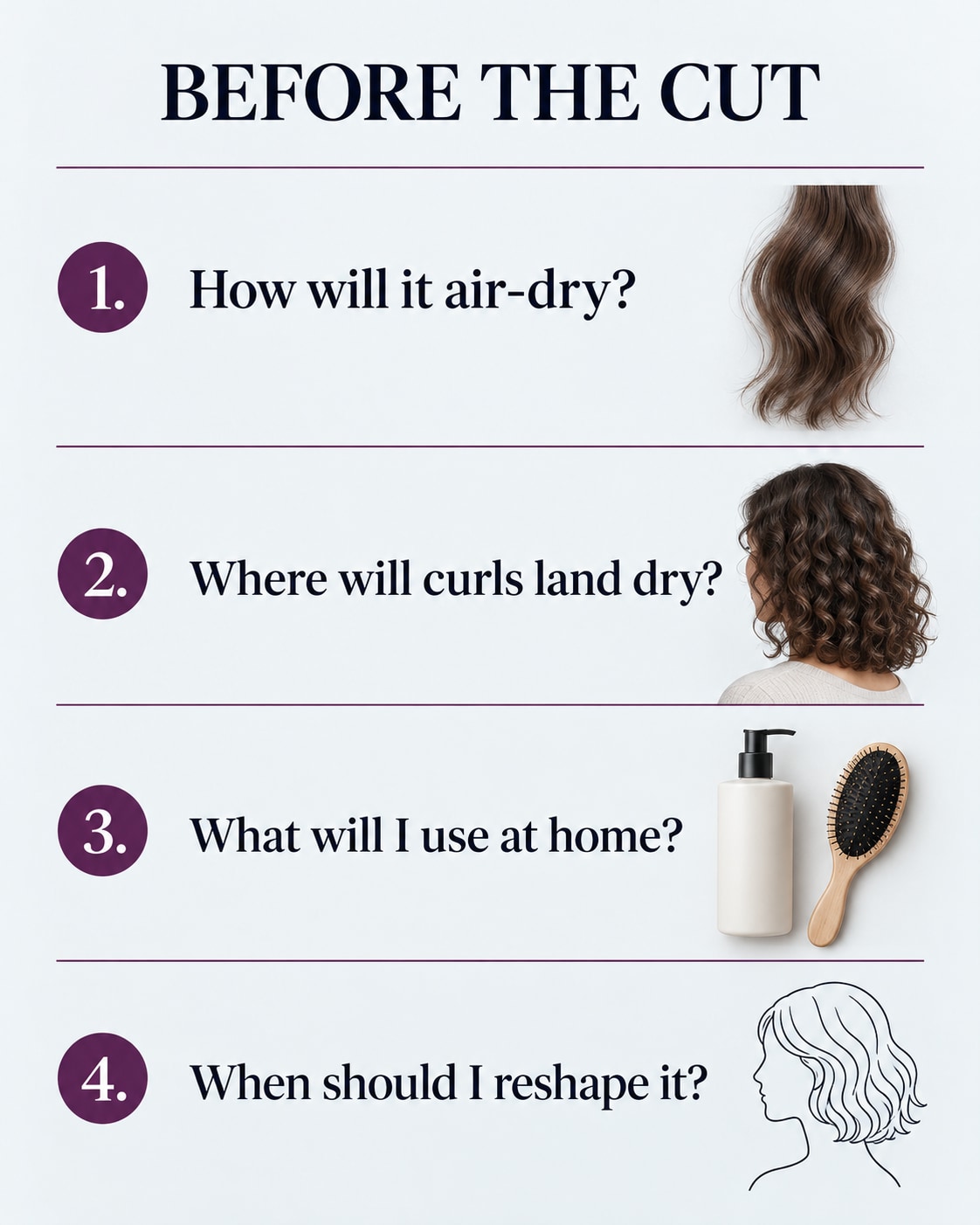
4 Critical Questions to Ask Your Stylist Before They Cut
- “How will this cut look if I air-dry it without a round brush or flat iron?” Ask which parts are likely to need a reset or heat if the reference is styled. Describe what you actually do after washing.
- “Where will my curls land when dry?” If your hair shrinks as it dries, ask the stylist to assess your own curl pattern and show the proposed dry endpoint. A fixed number of inches cannot predict every head of hair; see our curly-hair guide.
- “What product or tool would I need at home, and how would I use it?” Ask for a small demonstration that fits your routine, including where to apply a product and how much to start with. Sam Villa’s at-home styling guide recommends asking about tools, technique, and upkeep during the appointment.
- “What will change first as this grows, and when might I want to reshape it?” The answer may be the fringe, nape, or lower edge. Agree on signs to watch for instead of assuming one trim interval suits everyone.
Before the first cut, summarize the agreement in one sentence: “We are keeping the ends near my collarbone when dry, adding soft front layers from my chin, and leaving enough weight at the bottom for an air-dried finish.” Invite the stylist to correct any part that will behave differently on your hair.
What to Wear and How to Arrive at the Salon
Wear something that lets you and the stylist see your neck and shoulders. A bulky hood or high collar can obscure the length you are pointing to; if you arrive in one, move it out of the way for the consultation. Bring your hair in a state that shows its usual part and texture when practical. If you normally air-dry it, a freshly smoothed blowout may hide the growth patterns or curls you need to discuss.
Tell the stylist about recent heat styling, product, or a protective style if it changes how your hair looks that day. You do not need a perfect salon-ready finish. You need a clear account of how the hair behaves between visits and how much work you want to do at home.
Frequently Asked Questions
Is it rude to speak up during a haircut if I feel uncomfortable?
No. Speak up as soon as something differs from the agreed plan: “Can we pause and check the length before going shorter?” Calm, specific feedback gives both of you a chance to clarify the next step. If you cannot see the area being cut, ask for a mirror or for the stylist to show it to you.
How long should a good haircut consultation take?
There is no universal minimum. It should take enough time for you both to agree on the dry length, shape, styling expectations, and any concern you raised before cutting starts. A simple repeat cut may take less discussion than a major change. If you still disagree about the target length, ask to keep talking before the wash or cut.
Can I ask my stylist to show me how to blow-dry my new cut?
Yes. Ask for a demonstration on one section and then try the brush or dryer angle yourself if the stylist can safely guide you. Tell them what tools you already own and ask what simpler finish is possible on days you do not blow-dry. That makes the salon result a useful lesson rather than the only way the cut looks good.