The haircut library · Decision guide
Low-Maintenance Haircuts: What the Daily Routine Involves
A practical guide to cuts that work with the hair you have and the time you want to spend on it.
What makes a haircut low maintenance? Choose a shape that looks intentional when your hair dries in its natural texture. A softly edged collarbone cut is a flexible place to start if you want to tie your hair back, while a shag can make sense when you like your natural wave. Shorter isn't automatically easier: a pixie or precise bob may need a daily reset or more frequent shaping. Count the active styling steps and salon visits that your preferred finish actually needs.

Low maintenance describes a routine, not a particular length. A cut may be quick to arrange after washing yet take a long time to dry, or it may air-dry neatly but need its outline refreshed sooner than you want. Before choosing, picture your hair on an ordinary morning, at the end of a wash day, and several weeks after the salon visit. Our guide to choosing a haircut gives you a broader way to compare those priorities.
The Three Rules of Truly Low-Maintenance Hair
Work with your natural texture
If your hair forms waves or curls after a normal wash, a cut designed to show that movement usually asks less of you than one that only looks right when straightened. If your hair dries straight, you may prefer a simple outline over layers that need a brush to turn their ends. Check how the cut falls dry, in your usual part, without a salon blowout. Ask your stylist where the weight will sit once your hair settles naturally.
Air-drying is an option, not a promise that every texture will finish the same way. The American Academy of Dermatology advises that letting hair air-dry and reducing the frequency of blow-drying can help limit heat damage. The time until your hair is fully dry varies; a few active styling steps do not mean the whole drying process takes a few minutes.
Choose an edge you can live with as it grows
A precise, graphic line can be beautiful, but even small changes in length may be visible along it. A softly textured perimeter often has a less exact outline. That can make the grow-out feel more forgiving if you like that softer finish; it cannot guarantee a set number of weeks between cuts. Ask to see where the ends will land on your shoulders and how the shape may change as they grow.
Be careful with the word “layers.” A few blended pieces can release weight or encourage movement; a lot of short layers can create extra ends that need arranging. The choice depends on density and texture. Our layered haircut guide shows what changes when the weight is removed in different places.
Keep a practical fallback
If tying your hair back helps on busy days, check that the shortest front and nape pieces will actually reach a loose ponytail or bun. A collarbone cut often gives you that option, but the answer depends on the front length and your hairline. A clip or headband can help with pieces that escape. Keep ties comfortable and avoid repeatedly pulling hair tightly; the AAD’s hair-care guidance cautions that tight styles can cause damage.
Effortless Haircut Options by Length
1. A textured collarbone cut
This is a useful first option when you want visible length without a very long perimeter. Ask for an edge that looks good with your natural bend and enough front length for the way you usually wear your hair. On some hair, subtle internal shaping helps the wave move; on finer or lower-density hair, keeping more weight at the ends may make the outline look fuller. Neither version is a universal winner. Bring a photo with a texture close to yours, then ask how the cut will look without a round brush.
The trade-off is drying time. Hair at the collarbone is not necessarily quick to become fully dry, especially when it is dense. Its advantage may be the ability to leave it alone while it dries and tie it back later, rather than a guaranteed faster wash day.
2. A modern air-dry shag
A shag uses visible layers to create an irregular, moving outline. It can make natural waves part of the intended shape. Start with longer, softer layers if you want to test the idea without a dramatic short crown. Ask your stylist what the shortest layer will do when your hair dries and whether the lower edge will keep enough weight for your preference. See the guide to layers for a closer comparison.
Try your usual wash routine before assuming the cut needs only a dab of cream. Some waves separate with a little product and finger shaping; others need more water, hold, or a quick reset on the second day. Curly hair may also shrink as it dries, changing where layers land.
3. Long layers with curtain fringe
Long, blended layers can keep a tie-back option while making the ends less solid. A long curtain fringe can frame the face without a straight-across line. The fringe is the part to test: even when the rest of the hair air-dries well, roots near the forehead may split or fall into your eyes. Choose the shortest front piece based on how it behaves without heat, and decide whether you are willing to dampen and redirect it on some mornings. Our curtain-bangs guide covers that daily styling trade-off.
Long layers and a fringe do not automatically grow out invisibly for months. The center pieces may need attention before the overall length does. Ask about separate upkeep for the fringe and the rest of the haircut.
The “Short Hair Is Low Maintenance” Trap
A pixie removes wash-day length but often leaves pieces that show where you slept on them. You may need to dampen the roots, redirect a fringe, or use a little paste to restore the intended silhouette. A short bob can be easy if its shape follows your natural fall; a crisp bob that depends on a smooth, even edge may need brush styling after each wash.
Short cuts can also show growth sooner because a small change is a larger share of the style’s length. That is a reason to discuss salon upkeep, not a reason to avoid short hair or to assume every cut loses its shape after four weeks. Ask your stylist what will change first—the fringe, nape, or perimeter—and when you would want that area refreshed. If you prefer short hair and enjoy a quick daily reset, it may still be your lowest-effort choice overall.
A Five-Minute Active Routine for Wash-and-Go Hair
Think of five minutes as a trial budget for hands-on styling, not the time your hair needs to become dry. Test it after your next wash and adjust it for your texture and desired finish.
- Blot rather than rub. Use a soft towel or T-shirt to absorb excess water. The AAD recommends gentle towel wrapping because rough rubbing can damage hair.
- Add product only where it helps. If your ends need moisture or definition, smooth on a small amount of leave-in conditioner or texture cream according to the product directions. Skip it if your hair already settles well. Too much can weigh down fine hair.
- Set the shape, then stop handling it. Use your fingers to place the part and encourage waves or curls, or let straighter hair fall into its cut. Leave it to air-dry when that fits your schedule. If you use heat for a specific finish, choose a low or medium setting, as the AAD advises, and keep the dryer moving.
Wash-and-go
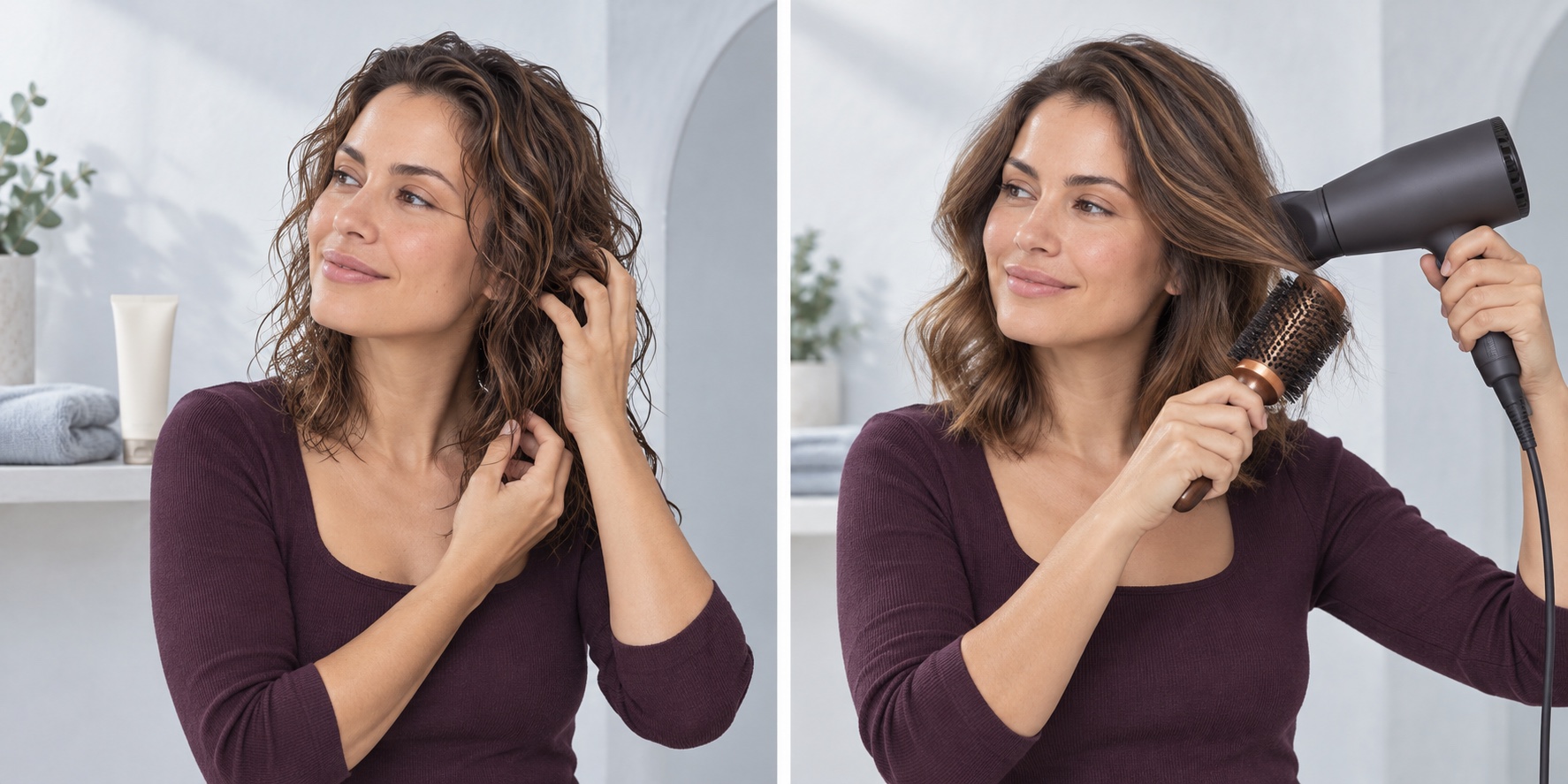
Blowout
Try the routine on a normal workday rather than judging it only after a salon visit. Note what happens at the roots, the front pieces, and the lower edge once fully dry. Those observations are useful instructions for your next haircut.
Frequently Asked Questions
What haircut requires the least styling in the morning?
The one that follows your natural growth pattern and dries into an outline you like. For someone with loose waves who wants a tie-back option, a softly shaped collarbone cut may work well. Someone with straight hair may need fewer steps with a simple one-length cut. Compare your actual wash-day and next-day routine before deciding.
Can low-maintenance cuts still look professional?
Yes. A neat natural wave, curl, or straight shape can suit a professional setting without a daily blowout. Choose the finish that feels appropriate for you and your workplace, then ask for a cut that makes it repeatable. “Polished” does not have to mean heat-styled.
How often should low-maintenance hair be trimmed?
There is no reliable interval for everyone. A short precise outline or fringe may need reshaping sooner than a long soft edge, but your texture, growth, and tolerance for change matter. Ask your stylist what to watch for: front pieces falling into your eyes, the nape changing shape, or ends no longer sitting where you want. Book the next cut around those signs instead of a universal 10-to-14-week rule.